Exports, Politics, and Economic Development: Pakistan, 1970-1982 (A Westview Replica Edition) by John Adams
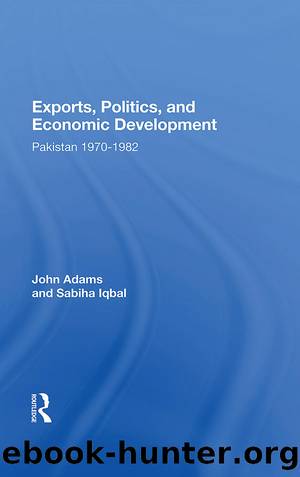
Author:John Adams [Adams, John]
Language: eng
Format: epub
Tags: Social Science, Political Science, World, Asian, Regional Studies
ISBN: 9780865319592
Google: YiqNDwAAQBAJ
Goodreads: 3980198
Publisher: Westview Press
Published: 1983-08-18T00:00:00+00:00
Direction of Exports
Tables 6.3 and 6.4 outline changes in the relative shares of exports going to different markets. The direction of exports has undergone a significant shift since the decade 1960 to 1970. During the 1960s there was a substantial reduction in the share of industrial countries from 49 percent in 1960 to 43 percent in 1970. Among the industrial markets, the share of the United Kingdom dropped from 16 to 10 percent, although the dollar value rose by one-quarter. The chief growing markets for Pakistanâs goods were the oil exporting countries and the centrally planned economies. Trade with the socialist countries increased three times as rapidly as total trade because of the negotiation of commodity trade agreements during 1963 to 1970. (1) The share of the United States rose slightly.
During the 1970s the share of industrial nations in Pakistanâs exports continued to decline. Their share reached a nadir in 1974 and has thereafter been somewhat unstable. The United Kingdom, Europe, Japan, and the United States have become relatively less important in Pakistanâs export picture, although there has been rapid absolute growth in dollar terms. The centrally planned economiesâ share has shrunk from 17.5 percent in 1970 to less than 3 percent in 1980. This decline resulted from a deliberate policy to reduce barter exports after Pakistan had accumulated a surplus of $63 million with these countries by the end of 1971/72. (2) The oil exporting countries have accounted for 20 to 27 percent of sales in the 1970s and 1980s, reflecting their rapid income growth and Pakistanâs links to the region. After 1976 there has been a recovery in the share of exports going to other developing economies. Among these, China became the single largest market for Pakistanâs exports in 1980, with its share rising to 8 percent of total exports as a result of a large shipment of raw cotton. (3) The strong export peformance after 1978 must be linked to Pakistanâs ability in recent years to maintain and expand access to historic markets while opening up new ones. The diversification of markets and the willingness to deal with an array of countries on a non-ideological basis has enhanced Pakistanâs competitive posture in international commerce.
Download
This site does not store any files on its server. We only index and link to content provided by other sites. Please contact the content providers to delete copyright contents if any and email us, we'll remove relevant links or contents immediately.
| Anthropology | Archaeology |
| Philosophy | Politics & Government |
| Social Sciences | Sociology |
| Women's Studies |
The Secret History by Donna Tartt(19088)
The Social Justice Warrior Handbook by Lisa De Pasquale(12190)
Thirteen Reasons Why by Jay Asher(8910)
This Is How You Lose Her by Junot Diaz(6887)
Weapons of Math Destruction by Cathy O'Neil(6280)
Zero to One by Peter Thiel(5802)
Beartown by Fredrik Backman(5754)
The Myth of the Strong Leader by Archie Brown(5507)
The Fire Next Time by James Baldwin(5446)
How Democracies Die by Steven Levitsky & Daniel Ziblatt(5219)
Promise Me, Dad by Joe Biden(5153)
Stone's Rules by Roger Stone(5088)
A Higher Loyalty: Truth, Lies, and Leadership by James Comey(4964)
100 Deadly Skills by Clint Emerson(4925)
Rise and Kill First by Ronen Bergman(4789)
Secrecy World by Jake Bernstein(4753)
The David Icke Guide to the Global Conspiracy (and how to end it) by David Icke(4720)
The Farm by Tom Rob Smith(4513)
The Doomsday Machine by Daniel Ellsberg(4490)
